Thursday, July 26, 2012

10th Annual Central City Opera Weekend

In the mountains above Idaho Springs, Colorado, lies a treasure called The City of Central, once known as the "richest square mile on Earth." At one time, it was the most prominent city in Colorado. Its Teller House Hotel was considered the finest such establishment west of the Mississippi.
The Opera House, built in 1872 by Welsh and Cornish miners, eventually fell into disuse as the city declined after the gold rush fever ran its course. It was reopened in 1932 and has been in continuous operation since then. This was our 10th annual visit to Central City and its jewel-box opera house. Few people realize what an incredible array of enjoyable activities take place in Central City between late June and early August year after year. Name performers, as well as a cadre of younger apprentices, come from around the country to take part in the annual festival.
This family of bears seems to be aware of something happening in Central City as they head up the Central City Parkway!
Since discovering the Chase Creek Inn Bed & Breakfast in 2004, it has become our base of operations for our visits to Central City.
Located in Blackhawk "around the corner from all the hustle and bustle of the gambling establishments," this B&B is an oasis of tranquility, with the Chase Creek gurgling alongside the house and birds chirping in the trees. Sitting on the porch, one can watch squirrels, chipmunks, rabbits, hummingbirds, bumblebees, and other creatures, while enjoying gentle breezes or quiet conversation. Here we are, having just arrived on Friday night.
The proprietors of the Chase Creek Inn B&B, Hal and Karen, always make our stay feel more like visiting family and friends than staying in a hotel.
There are three rooms in the Inn. This was ours this year.
Our Friday night meal tradition is to hike down to the Ameristar Hotel and Casino in Blackhawk to enjoy their delicious buffet.
I am usually too focused on the buffet to remember to snap a photo. Here we are at the Centennial Buffet at the Ameristar Hotel and Casino.
Free parking is available in one of the public lots. Here we are walking into town from the lot.
This picture was taken to illustrate the sagging of the building that houses the Easy Street Casino. One of our regular stops is Millie's, the restaurant on the top floor of this establishment.
In the afternoon, before our first opera, we had a sort of warmup called Short Works. It consists of three scenes from three different operatic works. In our case, we were treated to two advertisements for next seasons offerings, a scene from Showboat and one from The Barber of Seville. Additionally, they presented a scene from Rigoletto. Short Works are presented in the Williams Stables, across Eureka Street from the Opera House and Teller House.
On Saturday evening, we saw Oklahoma. Technically a musical, it was a wonderful night of musical entertainment, with lively, fun-filled singing and dancing and an appealing plot. Every year, the Central City Opera House Association tries to highlight opera in English, particularly American opera and at times, a musical. We have enjoyed seeing West Side Story (2008) and A Little Night Music (2009) in years past.  The American opera Susannah (2008) has become one of our favorites.
This year's offering of Oklahoma was a triumph. The excitement starts immediately and doesn't end until the final curtain falls. If our schedule permitted, we would see it again.
This is a shot of the Victorian style seen in the historic Teller House Hotel, as we made our way to the Face Bar for further musical entertainment.
This is the Teller House's "Face Bar," named for the picture painted on the floor of the bar.
We saw The Face on the Barroom Floor, the one-act opera by Henry Mollicone, performed in the Face Bar back in 2007.
This is the room next to the Face Bar, where about ten performers (including two of the main characters from Oklahoma) came to sing arias, show tunes, and comical songs until midnight. They call it "Après Opera," and it is loads of fun. This has become a regular part of our weekend.

One of the most hilarious of the offerings was the following. Ours was performed by a male soloist, but it's funny with this group, too. Check it out.
Our second opera of the weekend was La Bohème. This is Kathy's favorite, and Puccini is definitely one of my favorite composers of opera. It was very well done, and we enjoyed it immensely. After the excitement of the night before, it was of course, much more subdued, but that was to be expected.
Along with an English opera, the Central City Opera folks also perform an "old favorite" every year. This was it, and it did not disappoint devotees.
In addition to opera, there are other fun things going on during opera season. On Saturday, there was a mock gunfight on Main Street. One of the gun fighters showed up anachronistically on his Harley!


Our midday meal on Sundays is often at Millie's, a family-style restaurant on the second floor of the Easy Street Casino.
As in former years, an incredibly good time was had by all.
2011      2010     2009     2008     2007

Sunday, July 15, 2012

I'm Sixty!

Tengo sesenta años. I am sixty years old. Literally, I have sixty years. If I have sixty years, they have been given to me. I didn’t take them. They were given to me. The breaths. The wonders. The miracles. They are a gift—a gift for which I am very thankful.
私は六十歳です。(Watashi-wa roku-ju nen desu.) In Japan, the 60th birthday is the occasion of kanreki, when five cycles of the Chinese zodiac have completed, and the person is said to be reborn. During kanreki, the birthday person has a party with a cake decorated with white cranes and red turtles. The white cranes are a symbol of 1,000 years, and the red turtle represents 10,000 years. A sleeveless red jacket is given to the 60-year old, representing a baby's jacket and a return to the beginning of life.
我六十岁。(Wǒ lìu shí suì.) In Chinese culture, the 60th birthday is a landmark life event and worthy of celebration. The Chinese consider the age of 60 to be the completion of one life cycle. Those who achieve the plateau of 60 years begin a new life cycle at that point. Traditionally, a 60th birthday party is a major occasion in Chinese culture. Parties often take place in restaurants, preceded by games of mahjong before everyone sits down to enjoy the birthday meal. An appropriate menu must include noodles, which represent a long life. (Does spaghetti alio e olio count?)
בן־ששים שנה (Ben shishim shanah.) In Hebrew, my age is stated as “a son of sixty years.” Birthdays are not universally celebrated in Judaism. It is more common to mark the yahrzeit or anniversary of the date of a person’s death, which I understand to be a remembrance of the legacy of that person and a celebration of his or her life.
No matter which language one uses to express the age of 60, it is still six decades, three score, six times ten, five times twelve. It still comes after 59 and before 61. In our youth-oriented society, it is common to play down one’s age. Jack Benny always claimed to be 39. “Sixty is the new forty.” “You’re only as old as you feel, look, think, eat, etc.”
Everyone wants to be young, but wisdom comes with age. An accumulation of marvelous experiences only comes with time.
I have no intention of downplaying the age to which I have attained. I have been given sesenta años. I am a son of shishim shanah. I am blessed and thankful for those years. I have lived and continue to enjoy a wonderful life with an excellent wife, loving family and friends, and uncountable blessings.
I was once asked why I didn’t dye my hair when it started to turn gray. I replied, “It took me 50 years to grow these gray hairs, and I’m not going to hide them.” In Proverbs it says this: “Gray hair is a crown of splendor; it is attained in the way of righteousness.”
I’m sixty, and I couldn’t be happier about it.

Tuesday, July 10, 2012

Happy Anniversary, Ellie and Ryan

Happy anniversary, Ellie and Ryan.
Here you are thirteen years ago.
Thirteen, the number of ahavah (love) in Hebrew.
"Therefore shall a man leave his father and his mother, and shall cleave unto his wife: and they shall be one (echad) flesh."
Thirteen, also the number of echad (one) in Hebrew.
In your living room, you have a framed picture of this beautiful kanji (megumi), which means blessing, grace, mercy, kindness. Your marriage is a great blessing. Your home is filled with grace, mercy, and kindness.
It can be seen in the two of you and in the three wonderful boys you are raising. The four lower strokes of the kanji mean "heart." You take people into your heart as a way of life.

As you follow God together, you bring light and life into this world. We commend you for that. We love you and wish you many more years together.

I love Ryan's blog post about your anniversary.

New Blog: Writing Ellie

This blog is about my favorite things. Right at the top of that list are my children and the things they are doing. Ellie has a new blog, because sometimes it takes more than 140 characters to say what she wants to say. This blog is for those times. Check it out here.

I previously shared about Ellie's book review blog, Reading Ellie.
Check it out here.

Wednesday, July 04, 2012

Independence Day 2012

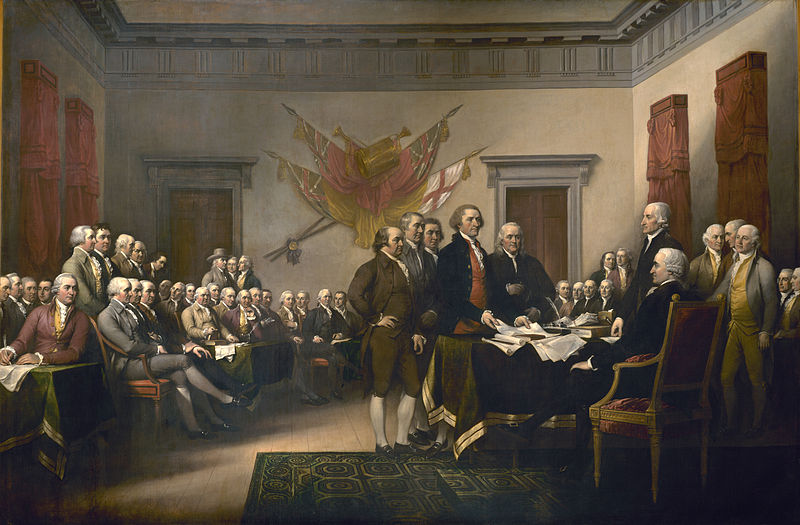
"When in the Course of human events..."
You have probably heard that phrase, no?
"We hold these truths to be self-evident, that all men are created equal, that they are endowed by their Creator with certain unalienable Rights, that among these are Life, Liberty and the pursuit of Happiness..."
You have probably even heard these words (although perhaps not in our present-day government schools; they might not want to mention a Creator).
But how many have heard these words? 
"The history of the present King of Great Britain is a history of repeated injuries and usurpations, all having in direct object the establishment of an absolute Tyranny over these States. To prove this, let Facts be submitted to a candid world.
The history of the present King of Great Britain is a history of repeated injuries and usurpations, all having in direct object the establishment of an absolute Tyranny over these States. To prove this, let Facts be submitted to a candid world.
He has refused his Assent to Laws, the most wholesome and necessary for the public good.

He has forbidden his Governors to pass Laws of immediate and pressing importance, unless suspended in their operation till his Assent should be obtained; and when so suspended, he has utterly neglected to attend to them.

He has refused to pass other Laws for the accommodation of large districts of people, unless those people would relinquish the right of Representation in the Legislature, a right inestimable to them and formidable to tyrants only.

He has called together legislative bodies at places unusual, uncomfortable, and distant from the depository of their public Records, for the sole purpose of fatiguing them into compliance with his measures.

He has dissolved Representative Houses repeatedly, for opposing with manly firmness his invasions on the rights of the people.

He has refused for a long time, after such dissolutions, to cause others to be elected; whereby the Legislative powers, incapable of Annihilation, have returned to the People at large for their exercise; the State remaining in the mean time exposed to all the dangers of invasion from without, and convulsions within.

He has endeavoured to prevent the population of these States; for that purpose obstructing the Laws for Naturalization of Foreigners; refusing to pass others to encourage their migrations hither, and raising the conditions of new Appropriations of Lands.

He has obstructed the Administration of Justice, by refusing his Assent to Laws for establishing Judiciary powers.

He has made Judges dependent on his Will alone, for the tenure of their offices, and the amount and payment of their salaries.

He has erected a multitude of New Offices, and sent hither swarms of Officers to harrass our people, and eat out their substance.

He has kept among us, in times of peace, Standing Armies without the Consent of our legislatures.

He has affected to render the Military independent of and superior to the Civil power.

He has combined with others to subject us to a jurisdiction foreign to our constitution, and unacknowledged by our laws; giving his Assent to their Acts of pretended Legislation:

For Quartering large bodies of armed troops among us:

For protecting them, by a mock Trial, from punishment for any Murders which they should commit on the Inhabitants of these States:

For cutting off our Trade with all parts of the world:

For imposing Taxes on us without our Consent:

For depriving us in many cases, of the benefits of Trial by Jury:

For transporting us beyond Seas to be tried for pretended offences

For abolishing the free System of English Laws in a neighbouring Province, establishing therein an Arbitrary government, and enlarging its Boundaries so as to render it at once an example and fit instrument for introducing the same absolute rule into these Colonies:

For taking away our Charters, abolishing our most valuable Laws, and altering fundamentally the Forms of our Governments:

For suspending our own Legislatures, and declaring themselves invested with power to legislate for us in all cases whatsoever.

He has abdicated Government here, by declaring us out of his Protection and waging War against us.

He has plundered our seas, ravaged our Coasts, burnt our towns, and destroyed the lives of our people.

He is at this time transporting large Armies of foreign Mercenaries to compleat the works of death, desolation and tyranny, already begun with circumstances of Cruelty & perfidy scarcely paralleled in the most barbarous ages, and totally unworthy the Head of a civilized nation.

He has constrained our fellow Citizens taken Captive on the high Seas to bear Arms against their Country, to become the executioners of their friends and Brethren, or to fall themselves by their Hands.

He has excited domestic insurrections amongst us, and has endeavoured to bring on the inhabitants of our frontiers, the merciless Indian Savages, whose known rule of warfare, is an undistinguished destruction of all ages, sexes and conditions.

In every stage of these Oppressions We have Petitioned for Redress in the most humble terms: Our repeated Petitions have been answered only by repeated injury. A Prince whose character is thus marked by every act which may define a Tyrant, is unfit to be the ruler of a free people"
...........................................................................................................................................................

"We, therefore, the Representatives of the united States of America, in General Congress, Assembled, appealing to the Supreme Judge of the world for the rectitude of our intentions, do, in the Name, and by Authority of the good People of these Colonies, solemnly publish and declare, That these United Colonies are, and of Right ought to be Free and Independent States; that they are Absolved from all Allegiance to the British Crown, and that all political connection between them and the State of Great Britain, is and ought to be totally dissolved; and that as Free and Independent States, they have full Power to levy War, conclude Peace, contract Alliances, establish Commerce, and to do all other Acts and Things which Independent States may of right do. And for the support of this Declaration, with a firm reliance on the protection of divine Providence, we mutually pledge to each other our Lives, our Fortunes and our sacred Honor."
Does that list of grievances sound at all famliar in today's world? Can you say the States vs. the bloated Federal Government?
Kyrie Eleison.
Lord have mercy.

Central City Opera July 2012 Wallpaper

Excited for our 10th Annual Central City Opera Weekend coming up in two weeks!

Sunday, June 10, 2012

Seven Seeds Coffee


Seven Seeds Coffee Roasters coffee has become our favorite. The most difficult part of drinking Seven Seeds coffee is trying to decide which variety we like the best! The flavor never fails to satisfy.
Seven Seeds Coffee Roasters is a new company, the new kids on the block. One of the reasons I love their company is their stated goal to improve the lives of indigenous coffee growers in needy countries.
Full disclosure. These folks are friends and relatives by marriage, but that doesn't mean my recommendation is not sincere and true. Love this coffee. Give it a try. You won't regret it.

Check out their web site here.

Tuesday, May 08, 2012

A Few More Thoughts on Hospitality

I asked friends and family for their understanding of hospitality, and I received so many great responses, I want to share some of them here for future reference.
The most humorous response came from brother-in-law Larry, who said that hospitality is a fatality caused by running into a hospital! (One for the Alternate Dictionary to be sure, but there’s that connection between hospital and hospitality, too.)
Friend and former shipmate Jim L. said that being hospitable includes respect, i.e. greetings (good morning, how are you, etc.), smiles, courtesies (please and thank you). It is like the Boy Scout motto (be prepared). He said further that, growing up, family and friends were always welcome and walked right into the house because they knew they were welcome. “We did not have much growing up, but we freely shared what we had.” What beautiful examples of hospitality.
Friend Ingrid remembers her mother making everything special for visitors, and Ingrid does the same. Out come the good cups and saucers, the nice plates, a nice table cloth, and cakes on a nice plate. She wants always to make her guests feel special by taking the time and trouble to share her best things—the best of herself—with her guests. It reminds me of a quote from Rex Stout’s fictional detective, Nero Wolfe, who said “The guest is a jewel resting on the cushion of hospitality.” Ingrid likens it to the Friday night celebration of Shabbat, a special time to bring out special dishes, table clothes, to prepare the house for guests, and to serve a fine meal with wine.
Co-worker and friend Rick points out that hospitality is a trait that is learned from one’s upbringing, from past generations, and from the social environment in which one grows up. My memories of the models of hospitality in our life are what led me to write something in the first place, so I cannot disagree. He opines that if one is grounded and confident, one will be more gracious and welcoming.
Cousin Sharon, who lived in Austria for years, expanding on Ingrid’s response, was astonished at the formality and beauty of the table set when invited for coffee in that country. There would be a beautiful table cloth, lovely china, cake and cookies—homemade or from some local bakery, gleaming silverware and a bowl piled high with fresh whipped cream. And as a guest she felt cherished and honored. She quickly learned that Austrians brought fresh flowers to the host on such occasions—a beautiful way to recognize the gift of hospitality.
In Greece, living on the island of Santorini, Sharon found a very different hospitality—equally warm but much less formal. There were occasions when Greeks would pull out all the stops and set a lavish banquet table for friends and family—the women would cook for days, bring out their best linens, china and glasses. There would be free-flowing wine—usually from their own vineyards or from the village their family came from. But what struck her most was the informal hospitality that friends were welcomed any time and that dropping by was the norm (as Jim L. shared earlier). When she was flustered that her apartment, which was also her artist’s studio, was cluttered with silk painting in progress, she would be reassured, “Sharon, we came to visit you, not your house.” She learned to keep snacks on hand for visitors who dropped in unexpectedly. And she observed that Greeks always offered a glass of water and fruit preserves (called a “spoon sweet” in contrast to finger-food sweets like cookies or chocolates). A bowl of fancy chocolates was always kept on hand—individually wrapped and festive looking—to offer to guests. While a guest often enjoys coffee or a glass of wine or juice, if it is a quick visit, everyone accepts a glass of water, recognizing and receiving the hospitality.
Kathy’s co-worker Debbie, a four-time visitor to Greece, including Santorini, agreed with Sharon’s articulation of the lavishness of Greek hospitality. She said she didn’t think she had ever eaten as much as she did in Greece. One woman, after setting two tables full of food, said she wished she had had time to make more! And they really couldn’t afford to do it, but they made their guests feel very special, indeed.
Debbie was also astonished at the hospitality of local villagers in Yemen, who would invite you in and offer you tea and sunflower seeds, or in one instance, the last piece of bread and the one bottle of Coca-Cola they had been saving for a special occasion.
Friend and former shipmate George offered this beautiful point of view. “To me hospitality means making your guests feel as if they are the most important people in the world to you at that time. You listen to them, care about what they say, make them feel at home, provide something to eat or drink, allow them to choose where to sit and talk, and offer assistance in any concerns or needs they may have. In other words, simply be there for them 100% while they are in your presence. Don’t answer that phone! Walk away from the TV!”
Sister-in-law Heather distilled it all as follows: “Hospitality is simply making sure people feel welcome.”
Friend-from-YWAM-Spain Bill observes that children need to see hospitality and the grace of good food, friendship and conversation modeled for them. It needs to start early, or it will not be imprinted on their minds. We so often miss the important for the urgent; the garden of hospitality needs time and care to become a desirable meeting place.
Friend and medical worker Christi wrote that when she would have conferences with families in her clinic, she would get a pitcher of water and glasses and make sure everyone had water. Kindness goes a long way, and since some of the conferences were about things not going well, mouths would get very dry when tensions were high.
One of the great things about this discussion on Facebook was that it brought together six distinct groups of family and friends, few of whom had met one another outside their own group, to share thoughts on a vital subject. As for the Lichtys, about whom I began to write, Vicki has put together an excellent five-page teaching on hospitality from a biblical perspective that she is likely willing to share. The Bartholomews now own and operate a Bed & Breakfast—what a great way to show hospitality.
May we all continue to give and receive hospitality in increasing measure and find new and creative ways to be hospitable, one to another.
While researching this topic, I discovered a fascinating 76-page PDF exposition of hospitality here.

A Few Thoughts on Hospitality

A couple of months ago, the idea came into my head to write something about hospitality. It came to me as I thought of all the wonderful times we have enjoyed and do enjoy when friends come to dinner or stay at our home or when we are hosted by others. I began to think of the great models of hospitality we have known in our lives, from friends and family who would host our visit when we came home on leave from around the world; to Bob and Vicki, who were with us in YWAM community in Spain; to Capt B and his wife, he the OIC/CO who had the greatest impact on my life in the Navy; to Don H and family, our chaplain in Spain and now the proprietor of the marvelous Spanish import store, La Tienda; to our friends Jim and Sue, who share their peaceful Estes Park home, Beit Shalom. The more I think about it, the more I see how much hospitality we have been shown throughout our lives.

I remembered delicious and often elegant meals, refreshing drinks, tasty teas and coffees, conversations, lively games and entertainments, as well as the little things that make one feel special upon arrival. I remember Vicki putting flowers and perhaps some tasty chocolates in guest rooms—along with a card welcoming them. That extra bit of effort made all the difference.
When we think of hospitality, often the first thing that comes to mind is food. My cousin Lissa kids that our family always takes pictures of the food, but we are really commemorating the people with whom we shared that food. The food is the occasion for the fellowship and as Antonio, her husband, likes to say, we are creating wonderful memories. These are the good old days, he says, for some future day in which, by the way, we’ll be busy making more good old days—not living in the past.

Yet, hospitality is much more than just serving good food and drink to our guests. True and complete hospitality involves sharing ourselves, our lives, with others and taking others into our hearts. There is an honesty and openness about welcoming others into our homes and to our table that says, “Here we are. What you see is what you get. We would love to get to know you, if you are willing.”

The biblical story of the Garden of Eden patterns the first hospitality. The Creator of the universe made a hospitable planet and planted a garden with all kinds of trees and plants in the midst of clear, cool, refreshing waters. The guests’ needs were perfectly provided for—nothing was held back.
.
Abraham is an archetype of hospitality. Sitting in his tent (which tradition says was open on all sides to provide for the needs of travelers), recovering in the heat of the day from his recent circumcision (at the age of 99!), he nevertheless jumps up and runs to greet three who approached, one of whom turned out to be the Almighty himself. He rushes to bring them water, both to drink and to bathe their feet, food to eat, and a place to rest before they should go on their way. Such was the way of Abraham and Sarah in greeting guests. It is said that Abraham required only that the guests return thanks to the one, true and living God in exchange for this hospitality (but nothing for himself).
The annual Alley family reunion is a great example of hospitality. Kathy’s family has been meeting together every year for nearly 60 years. For one fine weekend in late summer, we gather at a hotel near one or another of our homes, and we celebrate life together. We talk, laugh, talk, eat, talk, sing, talk, swim, joke, tease, get serious occasionally, and just enjoy one another’s presence. We have often spoken of the Alley reunion as a kind of hospital—a place we can enter, broken and battered by the challenges and vicissitudes of daily life, into a world of complete love and acceptance for a time. Hospitality.
I was amazed to find out (although I don’t know why) that the words hospital, hospitality, and host all come from the same Latin root. The root is hospes, which means guest, host, or stranger, and the related word hostis, means stranger or even enemy. So guests, hosts, and strangers are tied closely together in this word hospitality. Daughter Bonnie brought it together in this way, “A hospital is a place where strangers are welcomed in order to be healed. Therefore, hospitality is about welcoming strangers... in order that they may be made whole again.” Interestingly, according to the Online Etymology Dictionary, the usage of hospital as “shelter for the needy” predates the usage “institution for sick people” by about three hundred years, but the two meanings are clearly intimately entangled.

Jesus taught, “When you give a banquet, invite the poor, the crippled, the lame, and the blind.” Although we may not find occasion to welcome these folks into our own homes, we can support organizations that do, and we may volunteer with such organizations to bless these precious ones. I would suggest also, however, that there are those in our immediate circle of friends and acquaintances who are spiritually, emotionally and/or psychologically poor, crippled, lame, or blind. Are there any among us who can honestly say we do not suffer one or the other of these maladies in some way or another?

Our homes and our tables should be “hospitals” in which we make one another whole—healing the emotionally crippled, giving sight to the spiritually blind, binding up the broken-hearted, friending the unfriended, setting free the captive, building one another up in all of these realms, and providing a place of joy and song and fellowship and blessing for all through our hospitality. This is providing true shalom, which in all of its fullness means wholeness, completeness—that we might be complete, lacking in nothing.

Daughter Ellie states it well. She says, “I think hospitality means inviting people into your life. Sometimes it does mean bringing out the best and showing them that they are worth the effort, but other times, it means giving them a glimpse of your normal life. Letting them see that life is good, and something to be enjoyed to the fullest…even when it’s messy.” I love that. Bringing people into your life, bringing them into your heart. Friend Rich once commented that our home is “one of the happiest places in Colorado.” Toby’s friends recently said, “When we were there, they made us feel like family.” Those statements bless us so much for that is what we strive for our home to be—a place of happiness and blessing, of family, a place of hospitality, reflecting the hospitality we have been shown so bountifully.
As God showed that first hospitality to the couple in the Garden—inviting them into his life, into his heart, so we invite others into our lives, into our hearts with our hospitality. So may it be in increasing measure.